





A new version of QTCAD® has just been released!
Full release notes hereafter:

To the dear community of quantum scientists and engineers,
We are very happy to release a new version of QTCAD® which includes again some major new features and improvements in all of the software packages: for spin-based quantum devices, for the atomistic tight-binding model features, for the superconducting quantum systems and for our users’ quality of life with enhancements of the Builder and Visualizer tools, making of this version yet another marking and notable expansion of our unique-on the-market software.
Please find below the full release note of this version 2.2.0:
New spin-qubit modeling features and improvements in the `qtcad.device` package:
- Added a new “electron_kp module“ for encoding of Hamiltonians up to quadratic order in momentum. New workflows using this module:
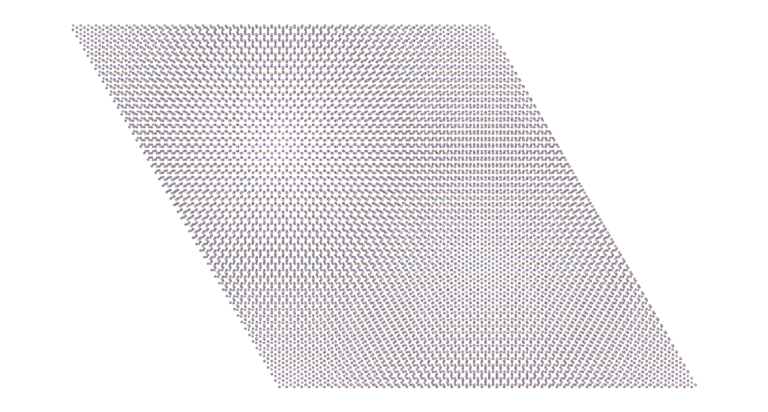
- A practical application for studying position-dependent valley splittings.
- A tutorial for modeling topologically protected bound states.
- Added support for setting a uniform valley splitting.
- Added new features to the Schrödinger-Poisson solver:
- Ability to specify a fixed degeneracy for bound-state orbitals.
- Support for electron states with band indices, such as spin or valley.
- Optimized Coulomb integrals evaluation. Up to 10x performance improvement in exact 3D exchange calculations!
-
Added a new practical application for simulating hole-based double quantum dots in germanium.Updated the symmetric meshing process to better handle edge cases.Fixed a bug in the Schrödinger solver that could cause a crash when using the `guess` parameter for holes, also resolving related issues in lever-arm matrix calculations
- Added the `toglobal` `Mesh` method for converting quantities from local nodes to global nodes.
- Introduced new materials:
- Added support for quaternary alloys to the `device.materials` module, enabling users to implement custom quaternary alloy materials for their simulations.
- Added two new materials to the `device.materials` module: silicon nitride (Si3N4) and silicon oxycarbonitride (SiOCN), the latter being a quaternary alloy with user specified O, C, and N concentrations.
- Refined the Si/SiGe and Ge/SiGe band-alignment parameters stored in the `SiGe_DFT`, `Si_strained_on_SiGe`, and `Ge_strained_on_SiGe` materials of the `device.materials` module with an expanded first-principles atomistic dataset, improving SiGe bandgap trends, capturing the known Δ-to-L crossover near high Ge concentration, and improving agreement with experimental band-offset references.
New spin-qubit modeling features and improvements in the `qtcad.atoms` package:
- Implemented a method to compute the effective g-factor for an arbitrary magnetic field orientation in `atoms.g_tensor.Solver.get_g_factor`.
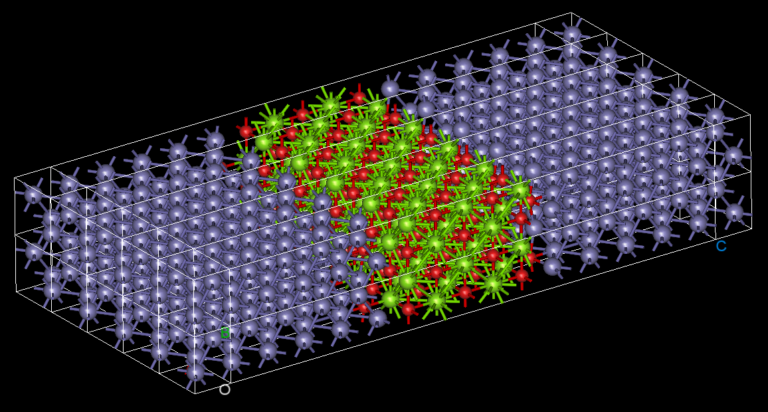
- Implemented a new algorithm for the atomistic tight-binding Schrödinger equation solver which uses around 40% less memory for sufficiently large systems, which may be enabled by setting the `memory_mode` attribute of the `qtcad.atoms.schrodinger.SolverParams` object to `”low”`.
- Implemented support for writing internal data structures of the atomistic tight-binding Schrödinger equation solver to disk, thereby enabling simulations of large systems that could otherwise not be performed with limited memory, albeit at the cost of increased runtime.
- Wrote new entry in the FAQ section of the online documentation addressing memory-usage of the atomistic tight-binding Schrödinger equation solver.
New superconducting-circuit modeling features and improvements in the `qtcad.device` package:
- Josephson-junction energy solver, `qtcad.transport.josephson_junction`, leveraging non-equilibrium Green’s functions (NEGF) and the Ambegaokar–Baratoff relation. This solver considers the geometry of the Josephson junction, along with a statistical model for the roughness of the Al/AlOx interfaces, and outputs the distribution of Josephson energies for an ensemble of junction samples. It also supports automated extraction of geometry parameters from 2D layout files, ensuring that the simulated geometry perfectly matches the intended device layout, bridging the gap between physical layout design (CAD) and numerical simulation. This new feature provides a unique and invaluable tool to study Josephson energy variability for realistic foundry processes.
- Driven Maxwell solver with adaptive meshing and microwave network analysis capabilities (S and Z matrices)
- Minor bugfixes in the Maxwell eigenmode solver
- `get_inductor_current` method in Device class
- `get_inductance` method in the `Device` class
- Improvements to `energy_e`, `energy_e_elems`, `energy_b`, and `energy_b_elems` methods in the `Device` class.
- New EM post-processing module: energy-participation-ratio analysis, `qtcad.device.epr`. Dressed frequencies, the qubit anharmonicity and Kerr coefficients, among others, can now be computed directly from QTCAD’s Maxwell eigenmode solver.
New features and improvements to the `qtcad.builder` package:
- Speed Optimizations: Significantly faster model fragmentation and complex layout file importing.
- Sub-Volume Isolation: Added a `clip_model` method to export and visualize specific model sections.
- Geometry Controls: Added non-uniform polygon scaling, `align_z_with`, and `undo_rotation` methods.
- Layout Support: Better hole identification in GDS/OASIS files and support for native GDS paths.
- Padding Update: Introduced `pad_group` (which supports padding both 2D and 3D geometries) and deprecated `pad_volume` (now reduced to an alias signature).
- Shape Growth: Removed the legacy `polygonize` argument and transitioned to a stable shape-growing method based on CGAL alpha wrapping.
- Removed the obsolete `finalize` method.
- `grow` (…) Signature: Added `grow_complexity`, `grow_accuracy`, `min_curve_nodes`; removed legacy parameters.
- `load_layout(…) Signature: Added `path_tolerance`
New features and improvements for visualization and postprocessing:
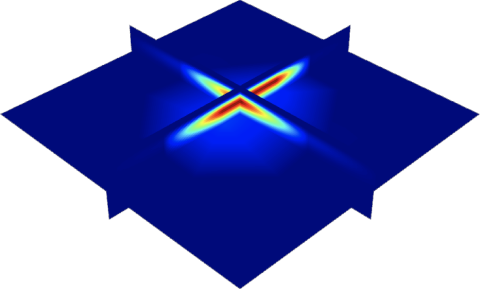
- Added multiple new post-processing options
- Slices
- Linecuts
- Isosurfaces
- Supports native view, jupyter notebooks, and headless servers
- Try it out with `device.show()`! Please let us know how to continue developping this feature.
Traditionally at each release, we want to thank very much for their trust all our active users and partners worldwide, a growing community of academics and professionals in the quantum sector.
We sincerely appreciate the increasing number and quality of our users, from both academic and industrial organizations, endorsing us, communicating with us with amazing improvement suggestions and reports and in particular through the publications of more and more scientific papers citing us and QTCAD®.
Some of our QTCAD® partners have been using our software for more than 4 years now, and we greatly value their invaluable and precious feedback and continuous support. We express a special thank you to them for helping us develop a reliable, powerful, and unique software solutions in the challenging and complex quantum computing industry market.
To join the QTCAD® community, simply create your user account on our portal and download the tool to test it: https://portal.nanoacademic.com/ It’s fast and easy.
The online documentation has been updated, you will find all the information on this new version here: QTCAD 2.2 — QTCAD 2.2 documentation (nanoacademic.com).
Link to the latest QTCAD® brochure: PLEASE CLICK HERE

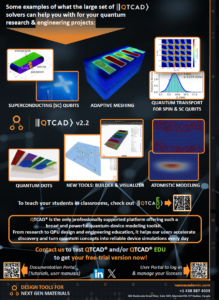
Also, do not miss checking out on QTCAD® EDU, a version of QTCAD® to teach students in classrooms: More information here.
Please follow us on LinkedIn and on X!
Thank you very much for your interest and continued support.
Nanoacademic’s Quantum Technology team in charge of QTCAD®.