




A new version of RESCU has just been released!
Hello to our community of materials scientists!
RESCU 2.10 introduces excited-state calculations and enhanced STM simulations
RESCU 2.10 is now available, expanding our density functional theory (DFT) software with new capabilities for studying optical transitions in quantum defects and simulating scanning tunneling microscopy (STM) images.
A major addition is excited-state modeling using constrained ΔSCF and the Initial Maximum Overlap Method (IMOM). Together with excited-state forces and structural relaxation, this enables calculations of zero-phonon lines (ZPLs), vertical absorption and emission energies, and Stokes and anti-Stokes relaxation energies.
Explore the new zero-phonon line tutorial
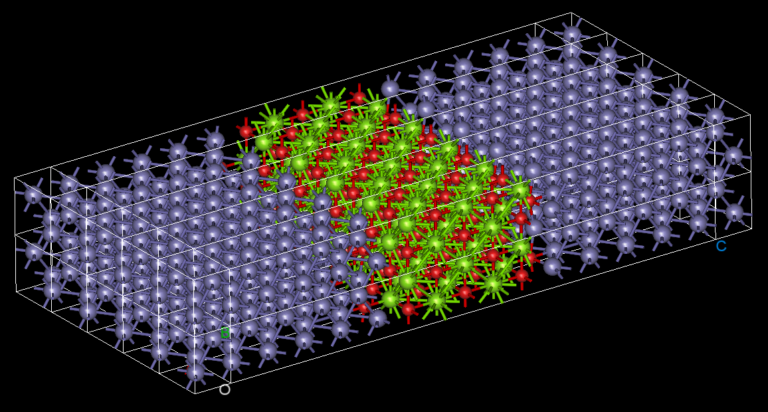
Our new tutorial guides users through a complete calculation for the negatively charged nitrogen-vacancy (NV⁻) center in diamond—a system relevant to quantum sensing, single-photon sources and spin qubits. It includes a 63-atom practice set, 511-atom production inputs, convergence scripts and comparisons with published calculations and experiment.
Using PBE and the 511-atom cell, RESCU yields a ZPL of 1.805 eV and a Stokes relaxation energy of 0.203 eV, closely matching the published PBE value of 0.204 eV for the latter.
Link to the ZPL tutorial:
https://docs.nanoacademic.com/rescu/tutorials/nv_center_zpl/nv_center_zpl/
Additional updates in RESCU 2.10
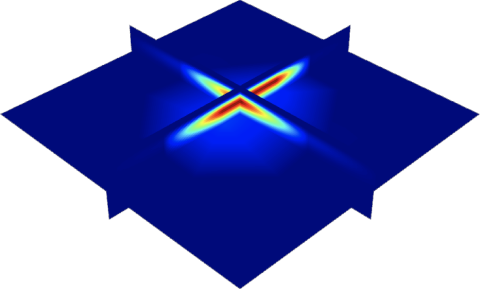
- Expanded STM simulation options: Chen’s derivative rule enables constant-height imaging with s-, p- and d-orbital tips and their mixtures.
- Spin-resolved STM imaging: Select the combined spin contribution or individual spin channels in Tersoff–Hamann outputs.
- Lower STM memory requirements: Stream the relevant LDOS planes for vacuum-propagated maps, enabling larger systems to be imaged with limited memory.
- STM corrections: Fixes address image alignment, vacuum propagation, periodic-z interpolation and spin-channel handling. Affected images and maps can differ from previous versions.
- Improved documentation: Reorganized guides, clarified input references, a standalone STM Bardeen tutorial and a tutorial on band offsets in strained Si/Si₁₋ₓGeₓ heterostructures.
Full release notes:
https://docs.nanoacademic.com/rescu/release_notes/
Do not forget to check out our weekly posts on LinkedIn especially the next one which will be focused on our main feature update: Zero-Phonon Lines of the NV centers in C diamonds, and the other ones about the new simulation capabilities of our DFT software solutions RESCU and NanoDCAL and in particular our innovative LatticeMind Agentic Simulation Assistant (CLICK HERE TO ACCESS TO THE LATTICEMIND v0.5 PAMPHLET), some simulation insights and more!
See you soon!